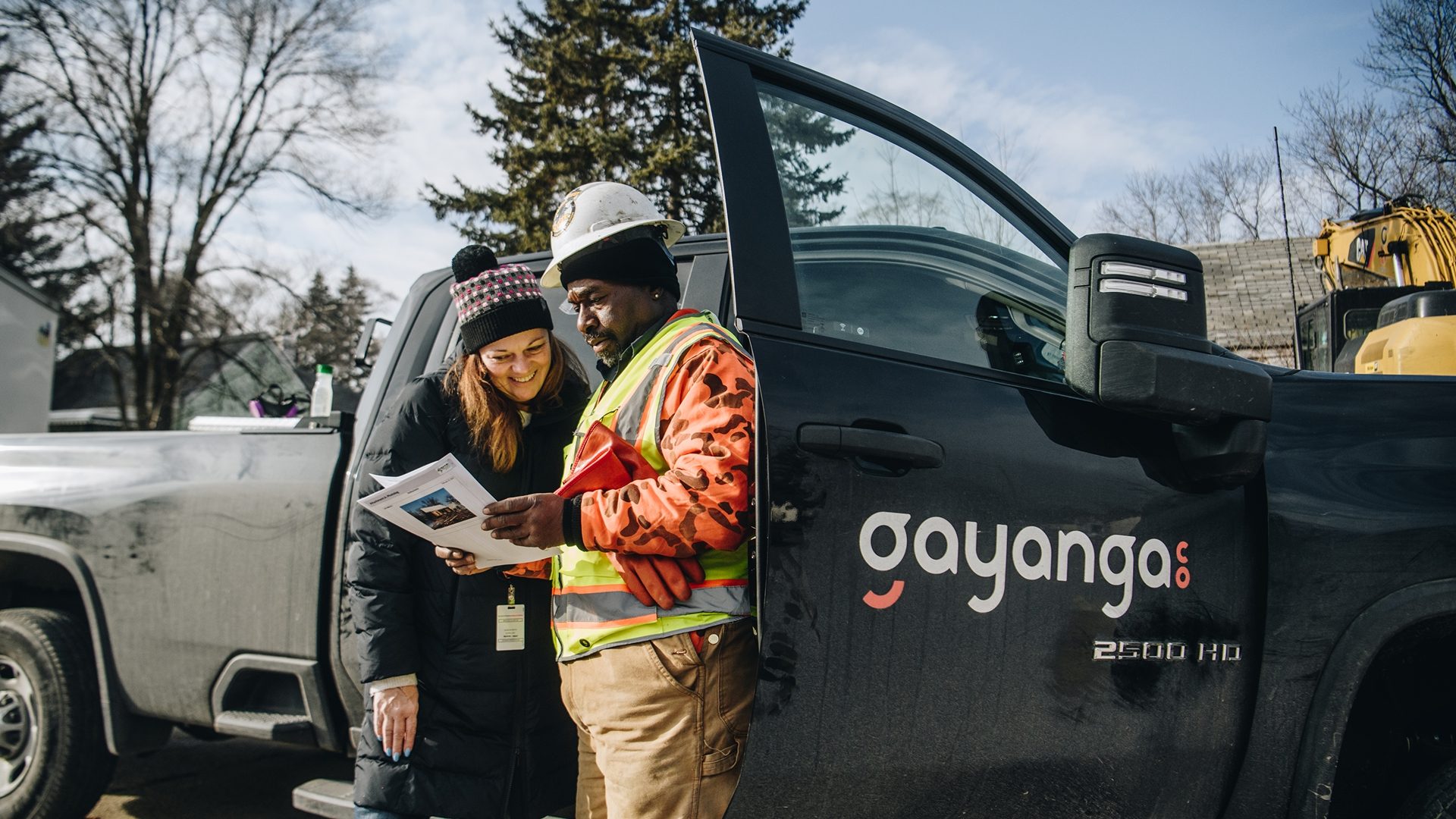
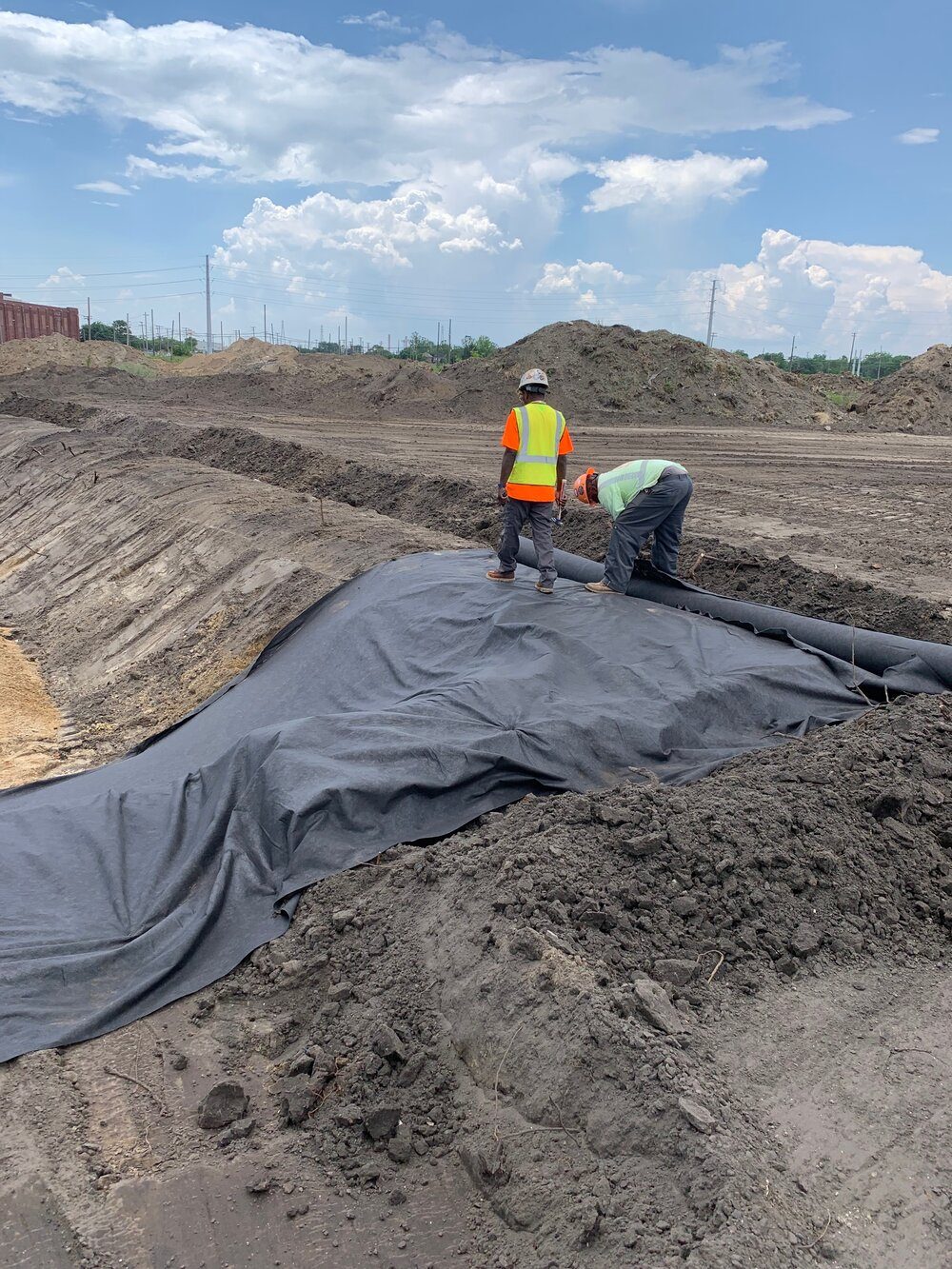
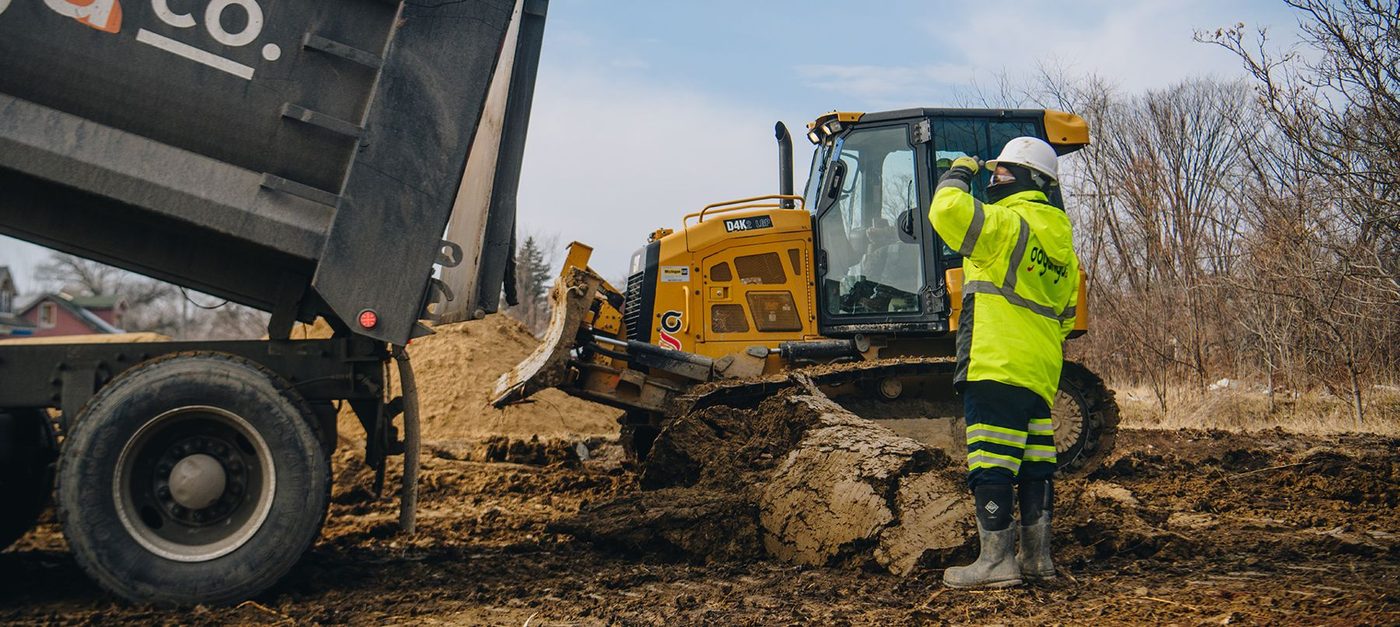
Gayanga Co. was a Detroit-headquartered, Black-owned heavy civil and demolition contractor built to create real careers for the people in the neighborhoods we rebuilt. From 2016 to 2026 we grew a 32-home contract into the largest Black-owned heavy civil and demolition firm in Michigan — more than $80 million of work, every dollar competitively bid. This is the record of what we built, who we built it with, and what happened at the end.
2016Founded in Detroit
≈2,500Structures demolished
$80M+In contract awards, including joint ventures — every City contract competitively bid
78Union-scale employees at our 2024 peak
Scroll to read
01The Name
A name that means self-determination.
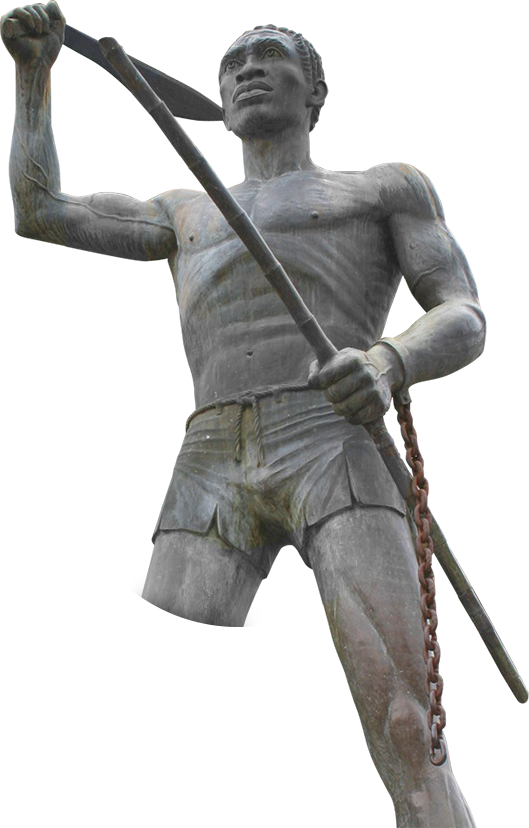
Gayanga takes its name from Gaspar Yanga, who led escaped enslaved Africans in colonial Mexico and founded the first free colony of Africans in North America — a community built on liberty and self-determination.
Too many "Black-owned" construction companies are Black in name only.
A Black name on the truck, a Black founder at the press conference — and a company that is white where it counts: who owns the equipment, who runs the crews, who keeps the profit.
Gayanga was named so it could never be that.
Black ownership that owned the work: its own crews, its own iron, its own estimators, its own decisions. It was about who did the work, who got paid a living wage for it, and who could say they built something in their own city.
Gayanga Co. was a place where people built their dreams. Our focus was on people. We weren't solely creating jobs — we were creating opportunities.Brian McKinney Sr., Founder & CEO
02The Founding
Founded in 2016 to close a gap Detroit could see from every block.
Detroit was running the largest residential demolition program in the country. Very few of the firms doing the work were owned by Detroiters, and very few of the crews came from the neighborhoods being cleared. The Free Press documented it in 2018: in a majority-Black city, the demolition money was going overwhelmingly to large firms from outside it.
Brian McKinney, a native Detroiter, founded Gayanga Co. in 2016 as a certified minority-owned construction engineering firm headquartered in the city. The idea was simple: if Detroit was going to be rebuilt, Detroiters should be hired, trained, and paid to do it.
It was not easy to get in. Detroit required its own demolition license, the review board was made up largely of the contractors a newcomer would bid against, and a Black-owned company with no track record had to be bonded before it could bid a single group of houses.
MAY 2016
The Minority Contractors FairOf more than 400 participants at the City's Minority Contractors Fair, hosted by Mayor Duggan and Rev. Jesse Jackson, Gayanga was the only firm that followed through and became licensed to perform demolition.
SEPT 2017
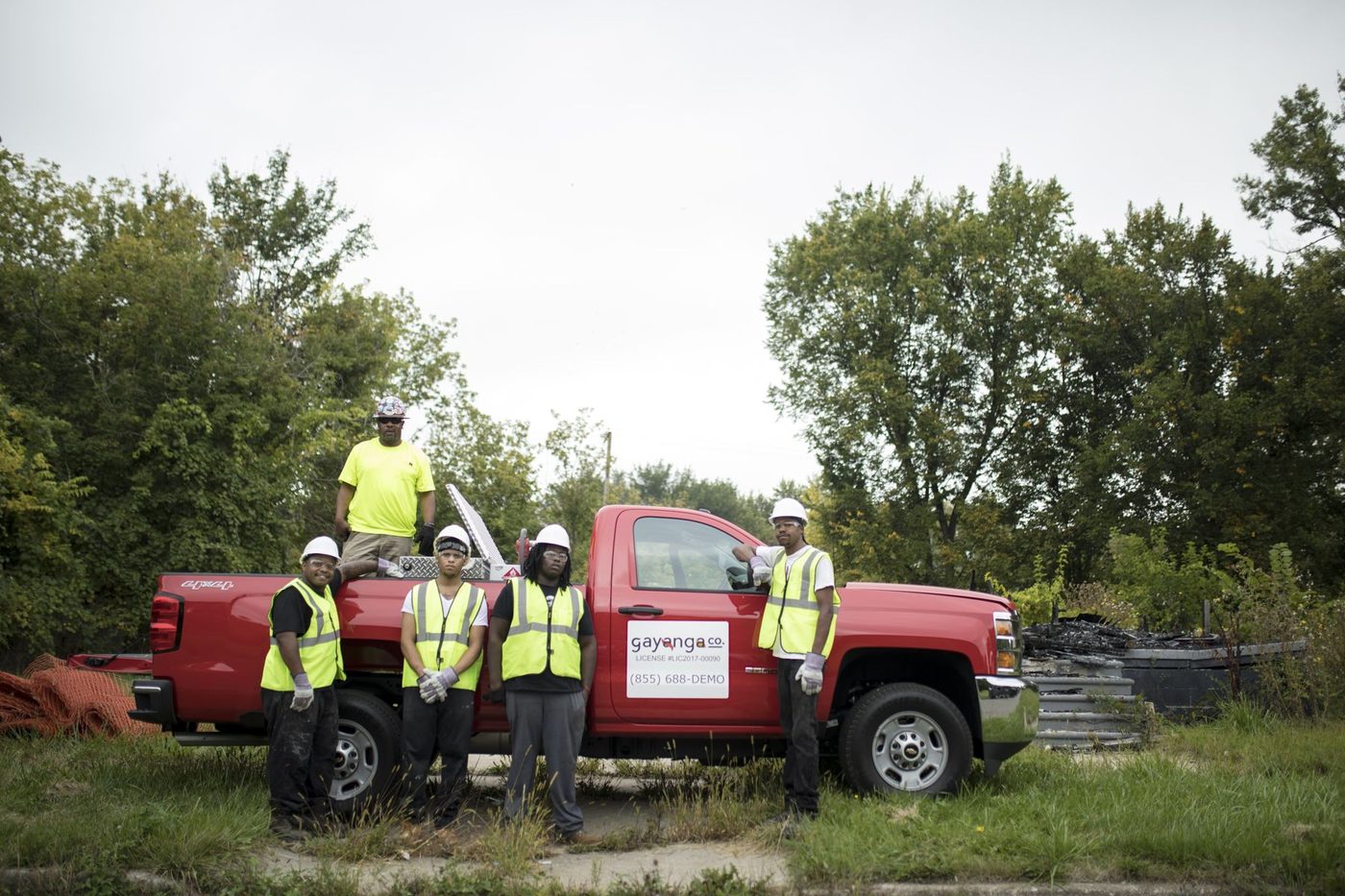
Demo Day — the first contract32 homes for the Detroit Land Bank under the Hardest Hit Fund — a contract of roughly $500,000. Gayanga's crews started on the east side and never left.
2017
Union before the first house came downSignatory with Operating Engineers Local 324 and Laborers Local 1191 before the first house came down — union wages, healthcare, pension, and training for every field position.
The first crew, Detroit, 2017
03How We Grew
From 32 houses to the largest Black-owned heavy civil and demolition contractor in Michigan.
32 homes in late 2017, 186 in 2018, more than 400 a year by 2019. City work grew from a $500,000 first contract to $17 million in 2021; revenue from $450,000 to nearly $18 million; bonding from $3.5 million to $12 million. And the work grew beyond demolition — water mains, earthwork, site development, industrial work for Marathon and DTE, and joint ventures on some of the biggest projects in the city.
32 → 400+
Homes demolished per year, 2017 to 2019
$500K → $17M
Annual City contract work, 2017 to 2021
$450K → $18M
Annual revenue, 2017 to 2024
$12M
Bonding capacity by 2025, up from $3.5M at the start
2016
Gayanga Co. was founded
Detroit-headquartered, certified minority-owned, licensed by the State and the City.
2017
First demolitions for the Detroit Land Bank
32 homes under the Hardest Hit Fund, hiring from the neighborhoods where it worked.
2018
The year of surviving
When Gayanga said publicly that Hardest Hit Fund money was going overwhelmingly to large non-minority firms, the Land Bank's bidding rules changed in ways that shut it out of the regular bid groups. For nearly two years it lived on emergency demolitions and a water contract it won on its own — more than 700 water disconnects and basement pump-outs for the Detroit Building Authority under a $2.2 million contract, later extended and followed by a $2.25 million Water Related Services contract. Its first underground work; those crews became its water main teams. 186 homes demolished.
2019
Gordie Howe Bridge, Woodland, Conners Creek
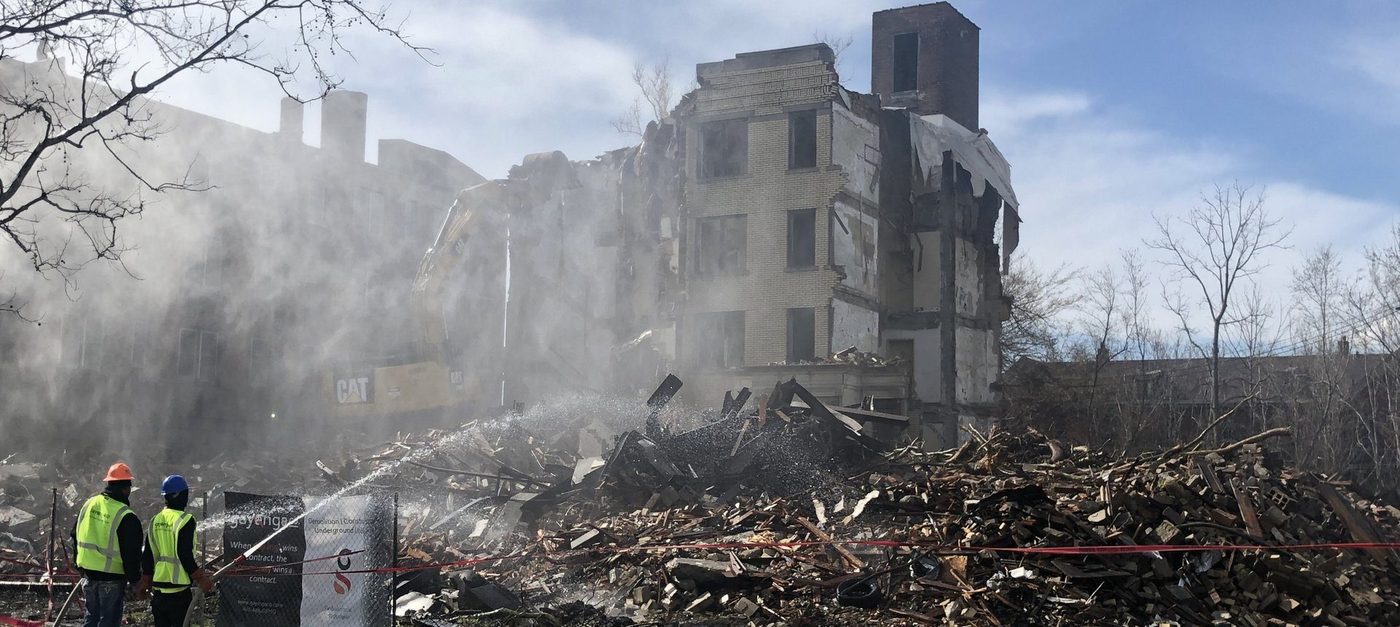
Selected directly by BNA Constructors to clear, grub, and grade the 160-acre Gordie Howe International Bridge port-of-entry site. Took the five-story Historic Woodland apartment building down in 10 days. Handled demolition, contaminated-soil removal, and ash-basin backfill at DTE's Conners Creek Power Plant. 400-plus homes demolished. Brian McKinney named to Crain's 40 Under 40.
2020
Proposal N
After Council rejected the Mayor's first blight bond, Gayanga's leadership and a coalition of Black contractors stood with Council members to push a rewritten proposal built around Detroit jobs and Detroit businesses. Voters approved Proposal N that November — $250 million, a 30 percent set-aside for Detroit small businesses, and a 51 percent Detroit-resident hiring target — and Mayor Duggan publicly credited Gayanga's CEO for helping get it passed. Gayanga then worked with Council and Locals 324 and 1191 on the equalization-credit amendments that gave Detroit-based union contractors a fair shot, and formed its first joint ventures with Major Cement.
2022
$18.45 million in Proposal N awards
BridgeDetroit's analysis showed Gayanga holding six Proposal N contracts worth about $18.45 million — the most of any contractor. Marathon Petroleum hired Gayanga as prime demolition contractor for its Boynton neighborhood program. The Major joint venture added the West Warren and East Warren streetscapes; a three-year DWSD water contract followed; the Workforce Development Program graduated its first cohort.
2023
The back office comes of age
The back office came of age: the City's Deputy CFO came over as CFO, the compliance specialist was hired out of the City's own demolition compliance department, and a safety and environmental manager recruited from Independence Excavating had authority over every site. 70 employees on payroll.
2024
Peak
78 employees, $3.3 million in payroll, and a network of Detroit-based subcontractors. Henry Ford Health selected Gayanga as a minority partner on its Destination: Grand campus expansion.
2025
The joint ventures
Gayanga and Major Contracting were awarded roughly $43 million of DWSD water main work for 2025–2027. Gayanga entered 2025 with more than $40 million of contracted work on the books.
Joint ventures and partnerships
Growing beyond demolition.
By 2025 Gayanga was a heavy civil contractor — water mains, underground utilities, streetscapes, earthwork, site development — often as the Detroit-based, Black-owned partner that let a larger firm meet the City's inclusion goals with a company that actually self-performed the work. The longest partnership was with Major Contracting, which Gayanga first hauled for in 2017. From 2020 the two bid the City's streetscape program through City-certified joint ventures — McNichols (PW-7004), Conant (PW-7016), Grand River and Puritan (PW-7017), Rosa Parks (PW-7015), West Warren (PW-7013), East Warren (PW-7034) — about $25 million of Public Works work, then DWSD water mains, and in 2025 a standing company, Gayanga Major Joint Venture LLC.
The engineering
An estimating and engineering department of its own.
Most contractors Gayanga's size bought their estimating from outside. Gayanga built it in. LaCresha Turner — an African American civil engineer, Detroit Public Schools graduate, and 25-year construction veteran — joined after the first award as Vice President of Engineering & Estimating and built the department that took the company from house-by-house bids to water main packages, streetscapes, and industrial work, training a bench of engineering interns along the way. When Gayanga had under $1 million in awards, that department did not exist; by 2022 it was pricing $25 million of work a year.
The industrial work
DTE and Marathon.
In 2019 Independence Excavating brought Gayanga on for DTE's Conners Creek Power Plant demolition — 20,000 cubic yards of contaminated soil, the ash basin backfilled, the Edison Boat Club demolished, 3,500 crew hours on a live industrial site. It put a Black-owned Detroit contractor on a power plant demolition of that scale, doing the heavy work. Independence's project manager closed the job with a note: "A great project, with great team members." In 2022 Marathon Petroleum, after its own safety prequalification, hired Gayanga directly for the Boynton neighborhood program beside the refinery and kept issuing work orders through 2025.
DWSD — with Major Contracting — 2025–2027
Streetscapes to water mains with Major Contracting
≈$43 million
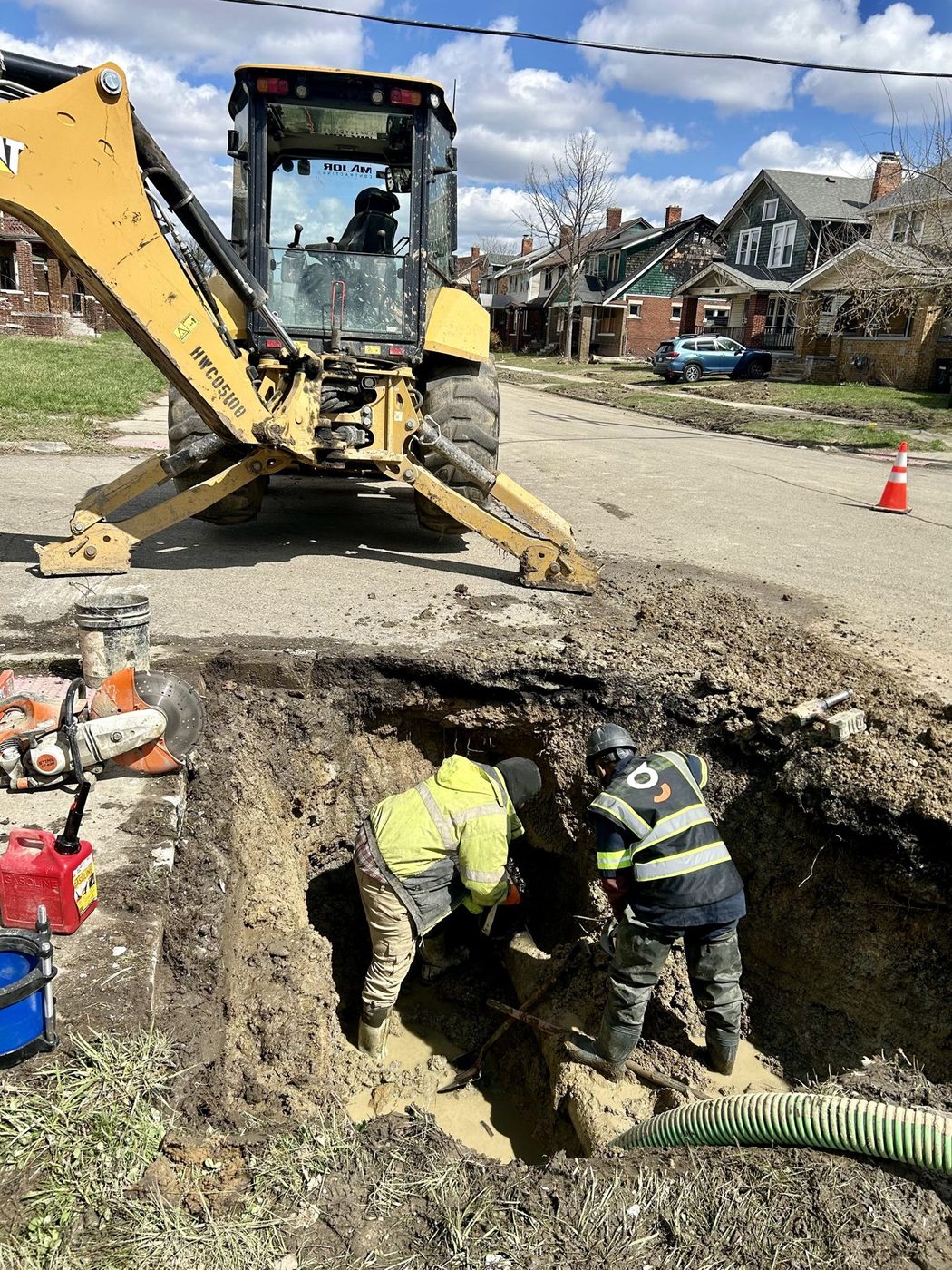
The partnership was awarded two DWSD water main replacement contracts, WS-744 and WS-745, running through 2027 — Gayanga's own crews in the trench and its trucks on the hauling.
Henry Ford Health — Barton Malow / Turner — 2024–2025
Destination: Grand campus expansion
Minority partner
Selected as a minority partner on the multibillion-dollar Henry Ford Health expansion in New Center — utilities, excavation, and concrete work on one of the largest health-care builds in Michigan.
Bridging North America — 2019
Gordie Howe International Bridge
160+ acres
Site clearing, grubbing, grading, erosion control, sediment ponds, and berm construction for what became one of the largest ports of entry in North America.
04The Work
By the numbers.
Approximately 2,500 structures demolished and more than $80 million in contracts across demolition, water, utilities, streetscapes, site work, and joint ventures — every City contract won through a competitive bid.
≈2,500
Blighted structures demolished in Detroit, 2017–2025
Total revenue, 2017 through 2025 — more than 90 percent of it City of Detroit work
14
Jobs touched by every single demolition: 7 abatement workers, 3 demolition crew, 4 truck drivers
City of Detroit — April 2019
Historic Woodland Apartments, 31 Woodland St.
10 days
A five-story, 44-unit apartment building taken down with a high-reach excavator in 10 days on a contract that allowed 120. Dust suppression and air monitoring throughout; the City's appeals board reviewed the job and cleared Gayanga.
City of Detroit — 2017–2025
Detroit Demolition Program
≈2,500 homes
Demolition, abatement management, backfill, grading, and hauling in every district of the city — from the Hardest Hit Fund through Proposal N.
DTE Energy / Independence Excavating — 2019–2020
Conners Creek Power Plant
20,000 cubic yards
Excavation, hauling, and Class II landfill disposal of 20,000 cubic yards of contaminated soil, ash-basin backfill, and demolition of the Edison Boat Club.
Marathon Petroleum — 2022–2025
Boynton neighborhood program
Prime contractor
Abatement, demolition, and backfill of refinery-purchased homes, performed directly for Marathon under its own safety program — nine job packages by 2025.
2017 – 2025
What it looked like.
Nine years of Detroiters doing the work — from the first two excavators to power plants, water mains, and the people who ran them.
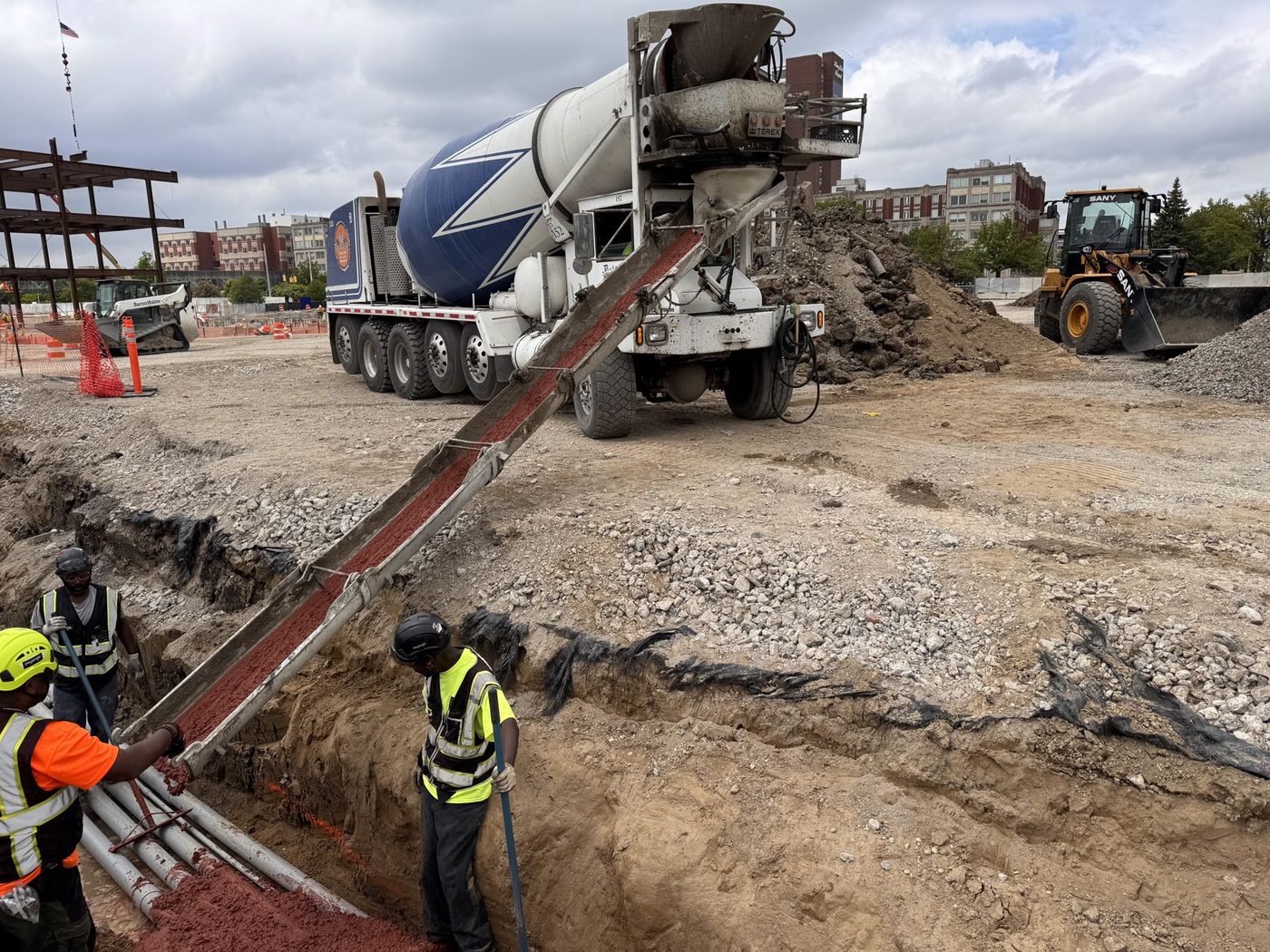
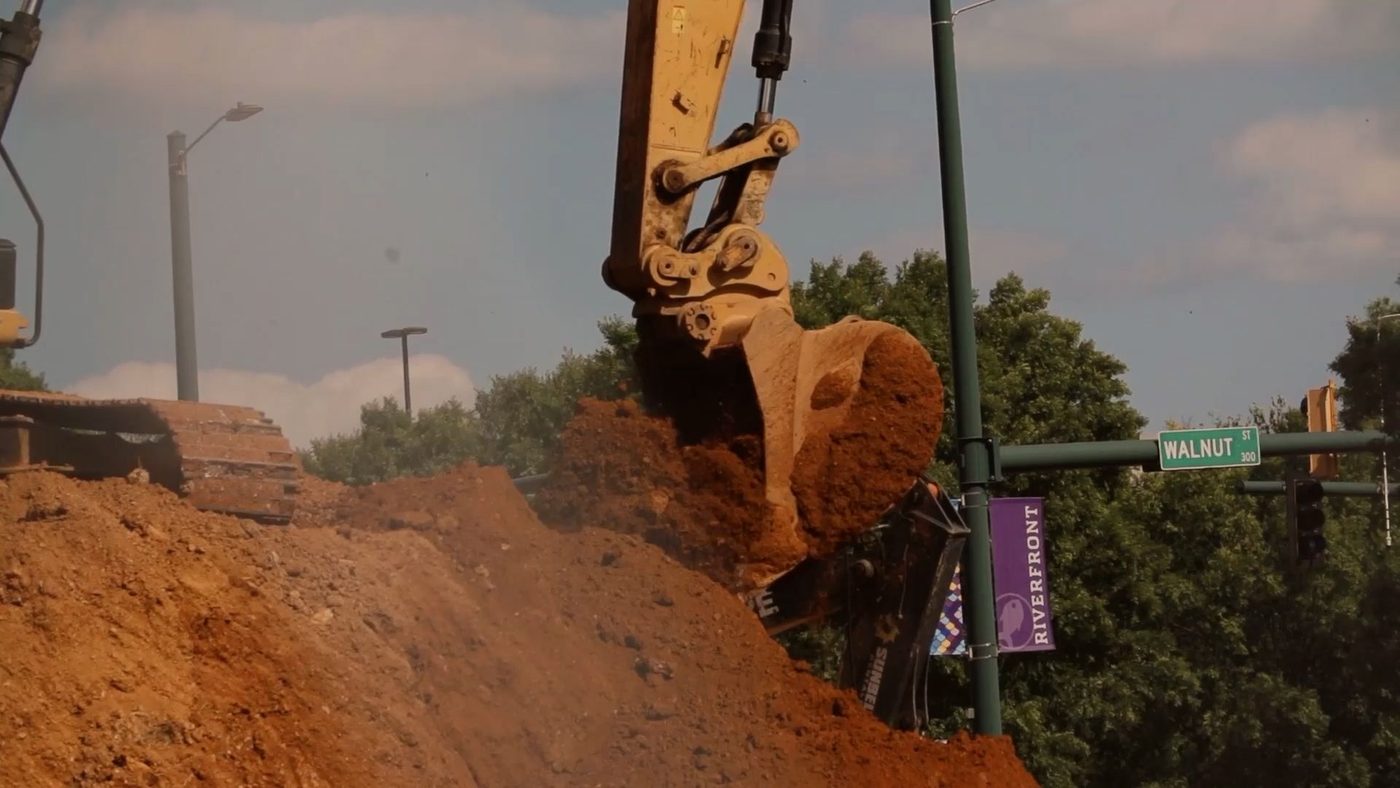
High-reach demolition — industrial workThe first new iron, 2017Residential demolition, dust suppression runningWater main crew, downtown skyline behind themRemote demolition robot on an industrial jobWorkforce Development Program cohort"When Gayanga wins a contract, the community wins a contract."Our own trucks on our own load-outsClearing and grubbingOne of roughly 2,500 structuresSignatory with Laborers Local 1191LaCresha Turner — Crain's Notable Women in Construction, 2022New dozer, union operatorsSorting and loading out — hauled by our own trucksMoving iron across the city — the Peterbilt fleet
05The Jobs
Union careers for Detroiters who had been told the trades were not for them.
No demolition contractor in the City's program had hired Detroiters from these neighborhoods at this scale — at union scale. From 2017 to 2025 Gayanga and its affiliates paid roughly $17 million in wages, about $5 million into the Local 1191, Local 324, and Local 207 pension, health, vacation, and training funds, and about $700,000 in company healthcare and retirement contributions for the office — nearly $23 million in all. At its 2024 peak, 78 people were on payroll; 85 percent lived in Detroit and 95 percent were Black or Hispanic.
We hired people who were unemployed, underemployed, or facing barriers to work — including returning citizens — and put them on a real ladder: pre-apprentice, apprentice, journeyman. Eighteen-year-old graduates started as Operating Engineer apprentices at $22 an hour plus benefits. The office was Detroit talent too — engineers, estimators, and project managers like Ed Davis and Phillip Nwachokor, running multimillion-dollar work.
Brian McKinney with Operating Engineers Local 324 and Laborers Local 1191 at the Historic Woodland demolition, 2019.
2017 – 2025
Put in Detroiters' pockets.
≈$0M
in wages and benefits, 2017–2025, paid by one Black-owned Detroit contractor and its affiliates
≈$0M
in wages
≈$0M
into union benefit funds
≈$0K
company healthcare & retirement
0
people on payroll at the 2024 peak
0%
lived in Detroit
0%
Black or Hispanic
$0
an hour for an apprentice operator — before benefits
Union scale, paid in Detroit — what an hour of work was worth at Gayanga in 2025
Operating Engineers Local 324
$0–$42/hr
Journeyman operators. With pension, health, and the other union funds, the 2025 Detroit scale package is $71.03 an hour.
Laborers Local 1191
$0–$32.84/hr
Journeyman laborers, plus the union's health, pension, and training funds. Apprentices reached $29.30 after 90 days.
CDL truck drivers
$0–$31/hr
Gayanga's own drivers, home every night — at and above the Detroit-area average for heavy-truck drivers, with company healthcare and a retirement match.
The ladder — upward mobility, one union card at a time
$22
Pre-apprenticefirst day, no experience
$29–31
ApprenticeLocal 1191 or Local 324
$31–42
Journeymanlaborer or operator
$35–43
Foreman /superintendent
$100K+
Superintendents andoffice leads, with benefits
Where the ≈$5 million in union benefit dollars went — every dollar to a fund for a Detroit worker
Pension and retiree funds
≈$2.3M
Health and welfare
≈$1.45M
Vacation and holiday
≈$930K
Apprenticeship and training
≈$165K
Annuity, labor-management, industry
≈$155K
Gayanga Co. has played a significant part in the revitalization of Detroit. Their team consists of 85% Detroiters and 95% minorities. This demolition company isn't just about getting the job done but being an asset to the community and being protective of the environment.City of Detroit Civil Rights, Inclusion & Opportunity Department, 2019
Otis, Operator — joined 2018
In comparison to other demolition companies, the work at Gayanga was not just about demolition. Employees had a chance to learn different parts of the construction industry and gain new skills through training.25-year operator who became a Local 324 union operator at Gayanga
Whitney, CDL Driver → Operating Engineer — joined 2019
A Southwestern High School graduate driving over the road, away from her young son. Driving for Gayanga in Detroit she earned more, came home every night, got her son back, and became a homeowner. Then she learned every truck, then every machine, went through the apprenticeship, and became a Local 324 heavy equipment operator.
Eric, CDL Driver
Eric earned his GED in prison and came home after more than a decade inside with no license and no work history. Gayanga helped him earn his CDL and put him behind the wheel of a company Peterbilt — union wages, union benefits, and a reason to be home every night.
Workforce Development Program — final cohort
Twelve weeks of free training in asbestos abatement, truck driving, and demolition labor — ending in a state asbestos supervisor license, OSHA 30, NCCER credentials, and a full-time job offer for every graduate. Run with partners including the Emerging Industries Training Institute.
100%
of students completed the program
91%
found new employment opportunities
88.9% → 14%
unemployment rate among graduates, before and after
06Built to Comply
We hired the City's own people to make sure we did it right.
A Black-owned contractor doing the most work in the program knew it would be watched more closely than anyone. So Gayanga built a compliance operation no other contractor its size carried — and paid for it out of its own margins.
It hired the people who already knew the City's rules and paid them to enforce those rules inside the company — every one recruited from the City, the Land Bank, or the region's largest union demolition firms.
Eric Higgs — Chief Financial Officer. The City of Detroit's Deputy CFO and Chief Accounting Officer for a decade after the bankruptcy; a CPA. Hired in 2023 to align Gayanga's controls with the City's own standards.
Sara Hernandez — Compliance and Quality Control. Recruited in 2023 from the City's demolition compliance department; the final check on every invoice and compliance package.
Ericka Meah — Director of Field Operations. Recruited from the City's General Services Department; she left Gayanga to become Chief Operating Officer of the Detroit Water and Sewerage Department.
Shantelle Hardaway — Engineering Support. Recruited from the Detroit Land Bank; ran the property-tracking system from wrecking permit to final grade.
John Maranian — Safety and Environmental Compliance Manager. A union safety professional from Independence Excavating and Homrich, with free rein over safety and environmental compliance on every site.
Project managers and general superintendents. Degreed engineers and construction managers like Ed Davis, and superintendents recruited from Barton Malow and Detroit Dismantling.
Field staff. Recruited from Adamo, Blaze, and the region's top union demolition firms — all union, all experienced, paid top wages.
It worked: from 2016 until the September 2025 suspension, every complaint raised against Gayanga was examined and found unsubstantiated. The most thorough test was the City of Detroit Office of Inspector General's own 2023 investigation, over an allegation about one individual's handling of load tickets. Gayanga turned over every ticket and source approval; the OIG interviewed the field and office staff one at a time, with no company leadership in the room; and on September 27, 2023, it closed the case with no evidence to substantiate the allegations. That is what a real investigation looks like. Two years later, on the same subject, the same office did none of it before publishing.
BSEED open-hole inspection. No backfill until City inspectors approved the excavation as clear and the sewer capped.
City-approved sources only. Material came only from sources approved by the City's consultant, AKT Peerless, or from the City's published public source list. Sources that were not approved were not used.
City liaisons on site at any time. They could arrive unannounced, stop the work, and approve or reject it. After 2023, Gayanga's sites were the most scrutinized in the program.
Documentation the City audited. Load tickets and photos for every delivery. In January 2025 the Construction & Demolition Department audited Gayanga's backfill records at random; its one question was a truck number written "19" on a form and "198" on the ticket.
Final grade approval. BSEED inspected and approved the finished grade before a site was closed.
Voluntary switch to public sources. At the end of 2023, after the OIG cleared it, Gayanga moved to the City's own public sources and City-recommended trucking — at roughly $4,000 to $5,000 more per property.
Tested three times. Never a finding of wrongdoing.
It was not the first time.
Every time someone came for Gayanga's name, the record was checked. Every time, it held.
2019
The claim
A local media personality claimed Gayanga had released asbestos into a neighborhood at 31 Woodland.
The record
Dust suppression ran throughout and an environmental firm monitored the air. On September 17, 2019, the City's demolition appeals board reviewed the data and cleared Gayanga.
2023
The claim
An allegation about one individual's handling of backfill load tickets — a claim about a person, not the company.
The record
Every ticket and source approval produced; field and office staff interviewed one at a time. Case closed September 27, 2023: no evidence to substantiate the allegations.
2025
The claim
The OIG announced Gayanga had filled its sites with contaminated dirt from a Northland Mall redevelopment.
The record
The Mayor's own review found otherwise. "We reported to the Inspector General that the idea that in the first half of 2024 large amounts of dirt came from other locations did not appear to be true." — Mayor Mike Duggan, December 22, 2025. Watch the briefing.
07Everything Was Bid
There was no favoritism. There was a bid tab.
Every demolition group in Detroit's program — Hardest Hit Fund, General Fund, Proposal N — was a sealed, competitive bid run by the City's procurement office. The lowest responsive bidder won. Gayanga bid on nearly all of them, lost far more than it won, and won its share. And under the City charter, Council does not select contractors; the Mayor's administration makes the awards and Council votes only to approve them. A Council member cannot hand anyone a contract.
Lowest bidder won
The City's terms were the same for everyone: if "the lowest bidder does not receive final contract approval, the City of Detroit reserves the right to award to the next lowest bidder." Prices, not relationships, decided the work.
1 of 4
June 2023: the City released Proposal N Groups Q7, Q8, Q9, and Q10 together. Gayanga bid all four and won one — Q10. The other three went to lower bidders.
3 of 18
Summer 2024: of eighteen emergency demolition bids the City opened, Gayanga won three. Other Detroit contractors won six, seven, and three.
City Council
Every contract went to City Council in public session with the bid tabulation attached — roughly $59 million of Gayanga awards between 2019 and 2022 alone, according to the Free Press.
Why a Detroit company could win at all.
Detroit's ordinance gave certified Detroit-headquartered businesses a small bid equalization credit to offset the cost of hiring residents and paying union scale. Gayanga earned it by actually being headquartered here, employing Detroiters, and paying prevailing wages — all verified by the City.
Proposal N added a 30 percent set-aside for Detroit small businesses and a 51 percent resident hiring requirement. Gayanga competed in that program alongside more than twenty other contractors.
And why we kept fighting for the ones who couldn't.
Gayanga pushed the City to enforce its own prequalification rules when firms with no employees beat qualified contractors, hired workers who had been paid in cash by non-union firms and put them on union payroll, and brought smaller Black contractors on as subcontractors, truckers, and abatement crews when it won.
No contractor in the demolition program created more living-wage jobs for Black and brown residents in the city of Detroit.Gayanga statement, October 2025
The fight for the rules
Gayanga was leaned on because it kept asking the City to enforce its own rules.
2018
Pushing for Black contractors in the program — and paying for itAfter a Free Press investigation into who was getting demolition money, Gayanga's leadership publicly pushed the City and the Land Bank for more Black contractors; the Free Press later reported a "surge in minority demo contracts." The rules also changed in ways that cut Gayanga out of the regular bid groups, and it survived on emergency demolitions until the City's own demolition department took over.
SEPT 26, 2022
Formal Proposal N bid protest — for the workers, not the workGayanga protested two Proposal N awards to J. Keith Construction — Group M1/SA ($2,932,717) and Group M4 ($2,624,021) — because the firm had prequalified without crews, equipment, or bonding, listing "employees" by photocopied driver's license and relying on cash-paid labor the rules did not allow. The point was not to win those groups. It was that people working demolition for cash, with no workers' compensation, were Black Detroiters who would be on their own the day one got hurt. The protest was upheld.
JAN – FEB 2023
Making the bid tabs public againWhen Proposal N award letters went out without the bid tabulations every public bid must disclose, Gayanga wrote to procurement on behalf of all bidders and would not let it drop. The Chief Procurement Officer acknowledged the gap and restored the tabs.
MAR 2023
Protesting for the contractors who feared retributionGayanga protested awards to a firm using "cash day laborers" to prequalify and gave the City a database showing which firms had won groups without the workforce to perform them. Other contractors agreed but were afraid to sign. Gayanga signed its name every time.
08The Moments
We were the company that cleaned up your neighborhood.
Giving back was not a program. It was the point.
1,000 meals
FEED Detroit
With the City's Parks & Recreation Department and FEED Detroit, Thanksgiving meals at four recreation centers — Adams Butzel, Farwell, Kemeny, and Joseph Walker Williams — and more packed and delivered the next day.
In the room
Meeting Detroiters where they were
Career fairs, high schools, recreation centers, the CDL class at Wayne County Community College, hiring days at the Northwest Activities Center, 1,500 freshmen from 22 Detroit high schools at Find Your Future, 750 more at United Way's Summer Career Connections Fair. Gayanga showed up, told people the jobs existed, and made sure the people telling them looked like them. When Brian McKinney saw women in that CDL class, he brought Whitney in to tell them one of Gayanga's best drivers was a woman.
Side by side
When the City needed us, we were there
When the City needed a contractor at a community meeting, a press conference, or a career fair, Gayanga went. When Gayanga celebrated, the City came: at the fifth-anniversary dinner, Conrad Mallett — then Deputy Mayor, now the City's Corporation Counsel — joined the toast.
09The Legacy
Why it was built — and what it left behind.
"The majority of the federal funds to demolish structures in highly impacted African-American community strongholds went to large suburban white companies that didn't hire anyone who looked like the people in the community." That was the founding problem, as Gayanga's CEO put it in 2020. Gayanga was built to change who was in the cab, who was in the office, and who was in the room.
The iron
New machines, run by Detroiters.
Gayanga started renting from Michigan CAT. Within a year it bought new — a CAT 336, two 323s, and a D4 dozer, $2 million of iron financed on a company that had done 32 houses. By 2025 the fleet was more than $4 million: Peterbilt tractors, lowboys and dump trains, excavators, dozers, and loaders — every one run by a union operator or CDL driver, nearly all Detroiters, and maintained by Gayanga's own mechanics. "No longer do African American residents only see themselves holding signs or flags on heavy infrastructure projects. They see themselves controlling the heavy equipment, creating the estimates, managing the projects." — Brian McKinney
The room
The only African American on the NDA board.
Gayanga joined the National Demolition Association early, because it knew what it did not know. In March 2023 Brian McKinney was elected to the NDA Board of Directors — the only African American at the table — and used the seat to bring more contractors who looked like Gayanga's crews into the industry. Gayanga was featured on the NDA's Demolition NOW podcast, taught at the 2024 and 2025 national conventions, and was invited back to co-facilitate the 2026 Superintendent Boot Camp. It was a national supporter of the National Society of Black Engineers.
The pipeline
Interns, scholarships, and a pipeline.
Every summer Gayanga brought in interns from Michigan, Wayne State, Michigan State, UM-Dearborn, Indiana, and Bowling Green — and turned interns into employees. It started in 2019 with Alexis Edge, a Detroit native, Michigan State environmental engineering student, and NSBE member who could not get an internship anywhere until Gayanga gave her one. She rebuilt the company's load-ticket tracking and built its first bid-estimating sheet — the start of the documentation system that later passed every audit — was named Summer Intern of the Year, came back in 2020, was offered a full-time engineering job, and went on to PepsiCo. Shelbi Hogan, a Wayne State civil engineering honors student, interned in 2022 and stayed on as a Gayanga engineer; Terrence Bartell interned the same summer as an officer of Michigan's NSBE chapter. Both won National Demolition Association scholarships in 2023 — Shelbi the Southern California Chapter Scholarship, Terrence the Mike and Nancy Taylor Scholarship — and Kameron Bowman of Indiana's Kelley School won the NDA's David P. Sinclair International Scholarship with Gayanga as sponsor. As one Council member put it: "there is no reason for anybody to say they can't find qualified Detroiters."
Seats at the table
Gayanga's leadership also served on the City's Board of Wrecking Examiners and the Metro Detroit Black Business Alliance, and co-founded JOURNi, a Detroit technology-education nonprofit. When Gayanga closed, it worked its partnerships — Major Contracting, Independence Excavating, and others — to place its people. The Black operators, drivers, laborers, engineers, and managers Gayanga trained are working today across the region. That was the point.
10Recognition
What was written about us — before September 2025.
For nearly a decade, the public record on Gayanga was a record of a company doing what it said it would do.
2018
Detroit Free Press"Detroit sees surge in minority demo contracts after Freep investigation" — Gayanga among the firms whose push changed the numbers.
2019
Detroit Free PressMayor Duggan: "We have an outstanding company, Gayanga … grew successfully."
2019
Crain's Detroit Business40 Under 40 — Brian McKinney.
2019
Crain's"10 Black entrepreneurs on the rise in Detroit" — 84 percent of the workforce living in the city.
2019
Black EnterpriseBE Modern Man — "Meet the Techie: Brian McKinney Sr."
2019
National Demolition AssociationDemolition NOW podcast — Gayanga on community and workforce development.
2020
DBusiness30 in Their Thirties — "from a $400,000 startup to a thriving contender."
2020
City of DetroitFirst Proposal N awards. Duggan: "There is the talent right here in Detroit to rebuild Detroit."
2021
CONEXPO-CON/AGG"Unconventional Recruiting Helps Detroit Demolition Company Flourish."
2022
Construction Digest"Began in 2017 with a $500,000 contract … last year $17 million in work from the city."
2022
Michigan ChronicleWomen of Excellence — LaCresha Turner.
2022
Crain'sNotable Women in Construction, Design & Architecture — LaCresha Turner.
2022
Michigan ChronicleMen of Excellence — Brian McKinney.
2022
BridgeDetroitThe most Proposal N contract dollars of any firm in the program.
2024
Crain'sNotable Black Business Leaders — Brian McKinney.
2024
Detroit Regional Chamber"Opportunity Rising" video series.
2024
EY Entrepreneur Of The YearMichigan & Northwest Ohio finalist.
2025
EY Entrepreneur Of The YearFinalist again — named May 2, 2025, four months before the suspension.
11The Record
What happened in 2025 — and what the record shows.
On September 11, 2025, the City of Detroit Office of Inspector General — the City's own OIG, not a state or federal office — publicly suspended Gayanga and its founder over backfill dirt, without first contacting the supplier it accused us of misrepresenting. The suspension expired March 11, 2026, at the 180-day limit, with no findings. By then the City had canceled every one of Gayanga's contracts, and a company built over a decade was gone. Everything below comes from public statements, public meetings, and Gayanga's complaint in Wayne County Circuit Court.
September 2023
Cleared once already.
A prior inquiry by the City's OIG, under Inspector General Ellen Ha, was not substantiated. Gayanga was cleared and moved all backfill to the City's public sources on its own initiative.
January – June 2024
The City accelerated the work and changed the dirt.
The City raised Gayanga's pace from 10–12 to 16–18 demolitions a week — on July 24, 2024, the Mayor's office wrote that "Mayor Duggan has asked to meet with you … to discuss demolition production," and the meeting was held in his office. Gayanga had a free, City-approved source of its own at Far West / Rouge Park. It moved to the City's public source list anyway, believing that after 2023 the public list gave it more protection. It bought where the City told every contractor to buy. Every load was documented; the City's own liaisons inspected the sites.
January 2025
The City audits Gayanga's backfill records.
The Construction & Demolition Department pulled Gayanga sites at random and audited the tickets and compliance forms. Its one question was a truck number typed "19" instead of "198." Eight months later the same department's testing would be the basis for a public suspension.
March – July 2025
Iron Horse.
Following the City's source list, Gayanga used Iron Horse of Michigan — approved by the City in 2023 and the kind of native pit the Mayor called "the gold standard for backfill" — at dozens of properties. SC Environmental, Adamo, and Salenbien used the same source at hundreds more.
September 11, 2025
Interim suspension, announced to the press.
The OIG suspended Gayanga and Brian McKinney, alleging the dirt came from a Northland Mall redevelopment and that "33 of 41" tested sites failed. Before publishing it had contacted one supplier — Ashley, which confirmed Gayanga's loads. It had not contacted Iron Horse, the source it accused Gayanga of misrepresenting; Major Contracting, which hauled most of the material; or any carrier. It had not interviewed Gayanga. It has never told Gayanga who made the allegations or what they were based on.
November 3, 2025
The City suspends Iron Horse.
After Gayanga named its supplier publicly, the City tested other contractors' sites, found the same contamination, and suspended Iron Horse.
November 18, 2025
City Council upholds the suspension, 9–0.
The City's Inspector General told Council Gayanga had "filled roughly 2,400 residential sites." Gayanga's field work stopped. Payroll for dozens of Detroiters stopped with it.
December 22, 2025
The Mayor's Final Blight Removal Report confirms what the OIG left out.
In his last week in office, Mayor Duggan disclosed that the OIG's tip — that Gayanga had filled "all of their holes" with Northland Mall material — had been checked with the supplier, which confirmed 309 of 323 sites. "The report was inaccurate," he said. Iron Horse had supplied four contractors at 424 sites, only 87 of them Gayanga's, and the City had "no evidence to believe that the contractors knew."
March 11, 2026
The suspension expires. No findings.
The suspension lapsed at the 180-day limit in the City's ordinance. No investigation — by the OIG, the police, or anyone — has found wrongdoing by Brian McKinney or anyone at Gayanga. But the City had canceled roughly $34 million of Proposal N contracts and Gayanga's share of the $43 million DWSD joint venture. There was nothing left to return to.
May 7, 2026
Gayanga closes — and files suit.
Gayanga closed its doors and filed a $100 million defamation lawsuit against the City of Detroit Office of Inspector General in Wayne County Circuit Court (Case No. 26-007722-CZ), so the full record could be examined in open court.
May – August 2026
The City moves to dismiss on immunity grounds.
The City's response was a motion to dismiss on governmental immunity — an argument that its Inspector General cannot be sued for what it said, not that what it said was true. Gayanga filed its opposition on August 7, 2026. The motion is pending.
There was no motive
Gayanga had clean, City-approved dirt for free. It spent its own money trying to find more.
The theory is that Gayanga bought cheap contaminated fill to save money. The record shows the opposite. Through its joint-venture partner's DWSD project at Far West Detroit / Rouge Park, 21800 West Warren — a City-owned site approved as a public source on resubmission by the City's Group Executive for Construction and Demolition — Gayanga had clean backfill at no cost, trucked to its sites at no cost. There was no financial reason to put anything else in a hole.
And Gayanga went looking for more clean dirt the hard way: from November 2024 to April 2025 it paid four laboratories and consultants to retest Waste Management's Woodland Meadows site — 900,000 tons of native soil — to get it approved for the whole program. A contractor trying to sneak bad dirt into Detroit does not spend six months and its own money trying to get good dirt approved.
What the OIG told the public — September 11, 2025
It is alleged Gayanga used contaminated dirt from a Northland Mall redevelopment in Southfield, Michigan to backfill residential properties in the City of Detroit.
Test results showed that the dirt located at 33 of the 41 (over 80%) properties tested thus far failed to meet the state's residential standards.
The expiration of the interim suspension is strictly the result of time limits imposed by the Debarment Ordinance and should not be interpreted as a finding or indication that Gayanga Co., LLC or Mr. McKinney has been cleared of wrongdoing.
City of Detroit Office of Inspector General, September 11, 2025, and its March 19, 2026 follow-up — issued after the suspension expired, three months after the Mayor's press conference, still citing "33 of 41."
What the Mayor told the public — Final Blight Removal Report, December 22, 2025
The first report we got was from the Office of the Inspector General, who said that they had a tip that in the first six months of 2024, Gayanga wasn't actually using approved sources. They were filling all of their holes with contamination from the Northland Mall. Now the tickets showed that the dirt came from Ashley, a native sand and gravel pit … We went out to Ashley and said to Ashley, did they get the dirt from you? And Ashley said in 309 of the 323 cases, they did get the dirt from us. And so, the report was inaccurate.
We reported to the Inspector General that the idea that in the first half of 2024 large amounts of dirt came from other locations did not appear to be true.
"We reported to the Inspector General that the idea that in the first half of 2024 large amounts of dirt came from other locations did not appear to be true."
Mayor Mike Duggan — December 22, 2025 — three months after the OIG suspended Gayanga on exactly that idea · Watch it
What an investigation looks like
The basics of any inquiry — and what happened here.
It is what the same office did in 2023, and what Gayanga's court filings lay out step by step.
Show the side-by-side comparison
An investigator normally
The City of Detroit Inspector General, 2025
Interviews the accused before accusing them.
Never interviewed Gayanga's leadership or the crews who ran the backfill before publishing. Its own office had done exactly that in 2023.
Verifies the tip against the sources named on the records.
Checked one source — Ashley, which confirmed 309 of 323 — then stopped. Never called Iron Horse, the joint-venture partner that hauled most of the material, or a single carrier.
Counts everything it knows.
Announced 41 sites. Left out the 323 the City had already checked — and put four of those already-checked sites on the "failed" list.
Corrects the record when the facts change.
After the Mayor said on December 22, 2025 that the theory "did not appear to be true," the OIG repeated "33 of 41 (over 80%)" on March 19, 2026, without updating a number.
Treats everyone in the same position the same way.
Four contractors used the same City-approved source with the same results. One was named, suspended, and stripped of its contracts.
Refers to the police after it investigates — not instead of investigating.
The suspension came September 11. By the Mayor's account the police were brought in September 17, and the OIG's own investigation was still "ongoing" six months later.
The 33
Look at the list the OIG called an 80 percent failure.
The OIG's "33 of 41" was the whole public case. The list of those 33 is attached to Gayanga's complaint. It breaks down like this.
15
were backfilled in 2025 with Iron Horse material — the City-approved source three other contractors were using at hundreds of sites, and that the City itself later suspended.
13
were on Tacoma Street, backfilled in 2022 and 2023, mostly from Far West Detroit — a City-owned site the City's own consultant approved.
4
were backfilled in the first half of 2024 from the Ashley pit — the exact period the City had already checked and reported to the OIG "did not appear to be true." They are on the OIG's own list: 3946 Lemay (January 5, 2024), 3526 Beatrice (February 12), 4563 Belvidere (April 4), and 6760 Brimson (June 4).
1
was backfilled in 2018, six years before the tip, under a different program.
The real percentage
What "over 80 percent" becomes when you count everything the City had already checked.
80%+
What the OIG announced: 33 of 41 sites "failed."
≈9%
The same 33 sites measured against everything that had actually been checked: the OIG's 41 plus the 323 first-half-2024 sites the City had already verified with the supplier — 360 sites, with the four that appear on both lists counted once. 33 of 360.
The arithmetic, using only the City's numbers: before the suspension the City checked 323 first-half-2024 sites with the supplier — 309 confirmed, 12 elevated, 2 clean, so 311 clean. The OIG had that information, announced the 41, and left out the 323. Together, counting the four properties on both lists once, 360 sites had been checked. The OIG's 33 against 360 is about 9 percent, not 80. Even adding the eight other elevated sites the City found, it is 41 of 360 — about 11 percent. Roughly nine of ten sites were clean.
Why did the announcement leave out the 309 sites the City had already confirmed?
Gayanga's answer, in its complaint, is that the OIG was looking for a contractor to blame, not for the truth. It never interviewed Gayanga's leadership or crews. It never called the supplier it accused Gayanga of misrepresenting. It relied on the City's Construction & Demolition Department to do the testing — the department that had approved every source. It referred the matter to the police six days after the suspension, not before. And none of the other three contractors using the same source had their staff questioned, their tickets pulled, or their contracts touched.
Every source in question — Far West Detroit, Ashley, Iron Horse — was approved by the City's Construction & Demolition Department and its consultant. That department set the pace, ran the liaisons, published the source list, and then conducted the testing the OIG relied on. A finding that the approved sources were bad is a finding about the department that approved them. A finding that one contractor cheated is not. Gayanga believes the second story was told because the first one could not be — and notes that the official who, as a deputy director of the Building Authority, oversaw the 2018 rule changes that pushed Gayanga out went on to run the department that approved these sources.
Fair questions for the Construction & Demolition Department and its director, Tim Palazzolo
Why has the department never answered for the sources it approved, the pace it set, the liaisons who inspected Gayanga's sites, the audit it passed Gayanga on in January 2025, or the testing it then conducted for the Inspector General on its own approved sources?
Why did it pay SC Environmental to demolish and fill 3314 Edsel, 1230 Patricia, 8392 Gartner, and 8087 Vanderbilt — then pay it again to dig the fill back out? That is paying twice for the same hole. Who decided that, and who approved it?
How many more times did that happen? Four surfaced in the public record; the department has more than 500 sites to remediate. How many of those purchase orders went to the contractors that put the material in the ground?
What did the City recover, and from whom? In May 2026 Law Department attorney Graham Anderson told Council cost recovery "is being pursued" — against Gayanga, as BridgeDetroit reported. Gayanga's sites are 87 of 424. Is the City pursuing SC Environmental, Adamo, and Salenbien for the other 337 — or paying them?
How did it remediate the wrong house — 8982 McClellan instead of 8990 McClellan — paying $27,280.64 for a property that never needed it, on a form its own director requested, while the contaminated house next door "will need to be rebid"?
Why did it approve Iron Horse — whose owner had pleaded guilty in the Kilpatrick-era corruption case to rigging a City bid — as the program's "gold standard," and never explain it?
And why, in May 2026, after one contractor had been destroyed, did it quietly rebuild the whole system — cutting its approved sources from fourteen to seven and testing every source itself, monthly, at the pit?
That reform is an admission of what was wrong before. Gayanga is asking who was responsible for it.
Gayanga does not say this with bitterness. It says it because the public record says it, and because the people who lost their jobs deserve to know why.
The Iron Horse record
One City-approved source. Four contractors. One publicly named.
Iron Horse of Michigan's pit in Milford was approved as a public source by the City's consultant on August 3, 2023, and was on the list the Construction & Demolition Department sent every contractor in 2024. What the City did not say is that Iron Horse's owner, Rodney Burrell, had pleaded guilty in 2010, in the federal case that ended the Kilpatrick administration, to submitting an inflated bid to help a Kilpatrick associate win a City contract — as BridgeDetroit reported after the suspension. Gayanga used it at dozens of properties in 2025 — 87 by the City's count. SC Environmental, Adamo, and Salenbien used it at hundreds more.
424
sites that received Iron Horse material — four contractors, 2024–2025
87
were Gayanga's. The other 337 belonged to SC Environmental, Adamo, and Salenbien — never named.
32%
of the first 50 Iron Horse sites tested, across all contractors, failed. The Mayor: "All of our contractors have exactly the same outcome."
1
contractor named and stripped of every contract: Gayanga. The other three kept theirs.
"The Gayanga dirty-dirt property" was not Gayanga's.
Press play: the March 9, 2026 exchange at City Council's Public Health & Safety Committee (56 seconds). The full meeting is on the City's eScribe site, at about 1:07:00. Download the clip
On March 9, 2026, a City official told Council that a contaminated site at 5558 Ivanhoe was "the Gayanga dirty-dirt property." State records list SC Environmental as the contractor, and the City had already paid $37,298.40 to remediate it. The program's most expensive cleanup, nearly $93,000 at 4551 25th Street, was SC Environmental's too.
We used the same City-approved sources on the City's own list, yet we alone were accused — and only after we identified our supplier and handed over the records did the City test other sites and find the same contamination elsewhere. Had the Inspector General investigated before making public accusations, this source would have been stopped sooner and far fewer holes filled with dirt that could have been contaminated.Gayanga Co. statement to the Detroit Free Press, June 25, 2026
Paid to fix their own work.
While the Law Department told Council that cost recovery "is being pursued" — against Gayanga — the City hired the contractor whose own sites had failed to do the cleanup, then, as the complaint states, had it perform "the majority of backfill replacement work on Gayanga's sites." The table below has the addresses and purchase orders.
By July 2026 the City had excavated more than 100 sites at roughly $35,000 each, with 450 to go and a total approaching $27 million — triple the Mayor's December forecast. Gayanga was the one contractor not working.
NOV 18
Contracts canceled — for one companyGayanga's counsel told Council the Law Department — now led by the same official who, as Deputy Mayor, had toasted the company at its fifth anniversary — had canceled all of Gayanga's contracts while "other similar companies, although they were suspended, their contracts were not terminated." A Council member asked why.
HONOR SYSTEM
The OIG's own description of the program"It's self reporting … There's no independent source of that." — City of Detroit Inspector General, November 18, 2025. Gayanga's tickets, photos, and City liaison inspections were the independent record the program lacked.
The SC Environmental record
Nine addresses, one contractor, $377,869.67 — and the wrong house.
Addresses, purchase orders, and amounts — checkable against the City's procurement records and the State's EGLE notifications.
Show the ten addresses, purchase orders, and amounts
Address
Demolished and backfilled by
City paid to remediate
Paid to
City PO
3314 Edsel
SC Environmental
$32,795.16
SC Environmental — to replace its own backfill
3093665 (bid 186735)
1230 Patricia
SC Environmental
$32,286.76
SC Environmental — to replace its own backfill
3094572
8392 Gartner
SC Environmental
$33,203.35
SC Environmental — to replace its own backfill
3095392
8087 Vanderbilt
SC Environmental
$44,756.40
SC Environmental — to replace its own backfill
3093487
5558 Ivanhoe
SC Environmental
$37,298.40
Another contractor
3091332
1330 Wheelock
SC Environmental
$36,514.80
Another contractor
3090851
6096 Chopin
SC Environmental
$31,204.80
Another contractor
3090726
11736 Mendota
SC Environmental
$36,930.00
Another contractor
3090720
4551 25th Street
SC Environmental
$92,880.00 — the most expensive cleanup in the program
Another contractor
3093166
8982 McClellan
— (the wrong address; the contaminated property was 8990 McClellan)
$27,280.64
SC Environmental — for a property that never needed the work
—
Every address in the first nine rows was SC Environmental's, not Gayanga's. The City paid SC Environmental $143,041.67 to redo its own work at four of them and other contractors $234,828 to fix five more — $377,869.67 for one contractor never publicly named. The last row is the City's admitted mistake: it fenced "the wrong address," paid SC Environmental $27,280.64 to dig out 8982 McClellan, and left the contaminated house next door, 8990 McClellan, to "be rebid." The requestor of record was the department's director.
You be the judge
The same rules, applied to everyone else.
Gayanga never asked for special treatment — only the treatment the City gave everyone else in the same program.
When employees of another contractor were actually charged
In 2019 two former Adamo Group employees pleaded guilty in federal court to bribery and bid-rigging in Detroit's demolition program. Adamo was not suspended, its contracts were not canceled, and it was still working in the program, using the same Iron Horse source, in 2025.
Gayanga: no employee charged, no finding of wrongdoing, company and founder suspended by name, every contract canceled.
When another contractor was suspended
In June 2022 the OIG suspended Inner City Contracting, a Detroit demolition contractor with nearly $10 million in program contracts. In September it rescinded the suspension. Its contracts had waited for it.
In November 2025 the OIG told Council an interim suspension means "all contracts are canceled." That is what happened to Gayanga — and not what happened to Inner City three years earlier.
When the City said it would go after the contractors responsible
The Mayor promised to "go after" those responsible. Instead the City paid SC Environmental $143,041.67 to replace its own backfill, $27,280.64 more to remediate the wrong address, and then hired it to replace the backfill on Gayanga's sites. Adamo and Salenbien kept working. So did Gayanga's joint-venture partner, which hauled most of Gayanga's material — never questioned, never named.
Gayanga, whose sites received the same material from the same City-approved source, was the only one of the four not working — and the only one named.
When and how it was announced
Announced to the press on September 11, 2025 — eight weeks before the mayoral election, with the founder's name in the headline, before anyone from the company had been asked a question. If the OIG believed individuals had done wrong, it never said who, or what. It suspended the company.
Gayanga believes the timing and the target were not accidents. Readers can draw their own conclusions from the record above.
87 of 424
By the City's count, Iron Horse material went to 424 sites across four contractors. Eighty-seven were Gayanga's. The OIG led with "33 of 41," never corrected it, never mentioned the 309 of 323 its own tip got wrong, and never named the other three — who kept working, and were then paid to clean up. The questions Gayanga has asked the court are simple: why the selective narrative, and who it was meant to protect.
12Our Statement
Proud of what we stood for. Proud of what we built.
Gayanga was built to create real opportunity for Black Detroiters in an industry where access has historically been limited. For nearly a decade we opened doors, built careers, and proved a Black-owned firm can compete and lead at the highest level. We bid for our work, competed fairly, and fought for smaller Black contractors. When Gayanga closed, no one filled the void. The union-scale jobs did not move to another company. They simply went away.
This is not only about one company. It sends a chilling message to the next generation of Black contractors and workers, and it left the smaller contractors, truckers, and partners who depended on this work dealing with the fallout. That is why we filed suit: so the truth can be told — for Gayanga, and for every community-based business striving for a fair shot in Detroit.
This chapter closed painfully. We remain proud of what Gayanga stood for, proud of the opportunities we created, and confident the truth will be told.
Brian McKinney Sr.Founder & CEO, Gayanga Co. — Detroit